
Advanced Swimbaits Part 2: Hooking the Fish

Since fisherman argue about nearly every topic presented to them it should come as no surprise that they argue about how and when to set the hook on swimbait fish. What makes this particular discussion so interesting is that both of the anglers involved have proven their method’s effectiveness. I (Matt Allen) believe that a hard and immediate hook set is the key to putting big bass in the boat consistently. On the other side of the fence you have my good friend Sieg Taylor. Sieg prefers to continue reeling then slowly applies hard pressure to the fish. While I staunchly oppose his method I must admit that I’ve seen it work for him on numerous occasions. Take a look at both approaches and then decide for yourself.

Let’s start with my approach:
When I am reeling and feel a fish “tick” my swimbait I hit them hard, really hard. I don’t believe there is any reason to wait. I don’t drop the rod and rear back, I don’t speed up my reeling, I simply swing high and to the side as soon as I feel pressure. I’ve personally seen too many fish suck a swimbait in and spit it back out quicker than the angler can react so why take your time and increase the likelihood of this happening to you? I believe that swimbaits target big bass and that big bass are inherently more cautious than small bass. Waiting to set the hook allows the fish too much time to realize something isn’t right. Setting the hook hard and fast allows you to bury the hooks deep while there is still time. Here is a prime example of my hook-setting style.

Sieg Taylor’s Approach:
Sieg and I spoke over the phone and he had some great insights to share. When asked how he sets the hooks he responded, “I don’t, I let them eat it. Once I know they’ve eaten the bait I reel hard and heavy, then swing them into the boat. Whether they’re 5 pounds or 10 pounds I swing them in.” He went on to share some of his experiences that led to his hook-setting style when he said, “When I won a Won Bass Pro-Am I actually saw it happening. I saw a 9 lber bumping the head of the swimbait over and over again. She would bump one side then the other. She was moving so quickly I could hardly see her motions. Instead of swinging I just kept a steady pace, that is when she inhaled it. The key is to keep reeling at the same speed. If the cadence breaks, you’re in trouble. If you swing and its not in their mouth, they’re gone.” Here is a prime example of Sieg’s hook setting style. If you watch closely you can see the fish has been on for several seconds before he leans back on the rod.

**Sieg asked that I add the true weight of this fish. Upon being weighed she tipped the scales at 8.56 lbs. Those Clearlake fish can be very misleading but Sieg wanted you all to know the final weight.

In closing, I’m not sure there is a right answer. Neither of us will waiver on our methods because we’ve both proven time and time again that they work. The next time you’re on the water give both methods a try then come back and share your experiences with the group. I look forward to hearing your thoughts. Until then, make your next day on the water a great one!

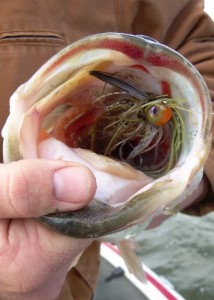
9 Lb Bass Crushes the Swim Jig

For those of you that read the California swim jig post, ran to tackle warehouse and completely wiped out their stock of 3/4 oz California swim jigs, this isn’t for you. But for everyone who ran there and found the baits were already sold out, I thought you might like to see a video that was sent to me yesterday afternoon.
Personally, I catch the majority of my fish on the 3/4 oz but the 1/2 oz has a time and place as well. Nationally, a lot of guys are using it with great success.
As I’ve said many times before, I don’t want all the videos on this site to be about me. I love when other anglers film great content. The timing was perfect when Dave from Florida sent me this video. He was wearing a head cam when a 9 lb bass completely inhaled his 1/2 oz Dirty Jigs swim jig. Its going to be an eye opening video for a lot of people. Not only do the baits work, they draw incredibly aggressive strikes, often from extremely pressured fish.
The good news is, at the time of this posting there are still a few 1/2 oz jigs available at tacklewarehouse. Here is the link: 1/2 oz California Swim Jigs

To all of Tacticalbassin’s readership, if you get a great catch on camera (on any bait) feel free to contact me via the “contact Us” link at the top of the page. If it seems like a good fit I’ll put it on the site. Tacticalbassin isn’t about me, its about the fisherman who come here to learn. I am all for user-generated content as I believe keeps the site relevant to cutting-edge trends around the country. I look forward to what you can come up with in the future.
Dave, thank you again for this submission. Great video, great fish, and perfect release.

California Swim Jigs

The trouble is, I don't follow a lot of the "rules" regarding how they should be fished. I'm a big fish, heavy line, stout hook kind of guy and it never made sense to me that it wouldn't work with a swim jig. Over the last few years I've been searching, experimenting, fine-tuning, and ultimately helping to develop a new genre of swim jigs known as the California swim jig.

The baits are available exclusively through Tackle Warehouse for the next 30 days and can be found via this link: Dirty Jigs California Swim Jig

If you've read my posts or watched my videos about swim jigs in the past what you've seen were the prototypes. You've probably even seen the jigs catching fish but didn't know that's what they were. Thanks to Curt Demerath of Dirty Jigs Tackle (the godfather of innovative jig design) the California-style swim jig is a reality. Curt and I put our minds together on this one and created a jig that swims unlike anything else and allows you to target fish that other jigs simply can't reach. Other companies will follow this trend (as they should) but make no mistake, you are witnessing the beginning of a whole new wave of swim jigs. In addition to an extra-heavy wire hook and custom weedless head design, the jigs come in a variety of swimbait-derived color schemes. You no longer have to settle for black/blue or matte white. You have colors like Tactical Trout, Light Hitch, Gizzard Shad, and many more to choose from. No matter where you are located in the world you can find a color to accurately match the baitfish in your local waters. The following video is approximately 7 minutes long and covers everything you need to know to get started. I discuss why the baits work, what sets them apart, and some of the unique approaches that make the jigs so fun.

I hope this jig impacts your fishing as tremendously as it has mine. When I first started to experiment with swimming big jigs I had no idea the caliber or quantity of big bass I would begin to catch. Its also important to understand that these baits are not enormous. While I've trophy-class bass on the swim jig I've also caught significant numbers of 1-2 lb fish and have found the baits to be equally capable at filling a limit. The baits have worked equally both day and night and have produced fish in every month of the year. Pick up a California Swim Jig today and see what all the fuss is about. I look forward to hearing the stories and seeing the photos in the weeks and months to come. Dirty Jigs California Swim Jig


Beating the Bank for Giants: Part 2

In recent years technology has really spoiled a lot of bass fisherman. There are 21-foot bass boats with 250 horsepower motors that are nearly whisper quiet at an idle, new electronics with ten inch displays that literally show you a scrolling picture of what the bottom looks like from one side of your boat all the way to the other. Guess what? You can also mark that fence line you just found on the picture with a G.P.S. point so you can come right back to it and make an exact parallel cast to it on your first attempt. All of these luxuries have made the learning curve of bass fishing much shorter.
That said, not everyone is blessed to have all of these tools working in their favor, especially young anglers. Some of the young anglers don’t even want these items and would rather stay with the basics. For them and for a growing percentage of bass fisherman, bank fishing is the only option. Just because you don’t have any of the new toys doesn’t mean that you can’t take bank fishing to the next level.
When planning a trip to target giant bass from the bank, you’re going to have to take a few things into account. Some lakes are going to have limited shore access whether it be reeds, lily pads, grass mats or unsafe slopes. Then you have the problem of a lake having too many spots to choose from and you can find yourself trying to hit as many spots as you can, not spending the time to slow down and fish a spot effectively.

Choose a lake where you know you can reach prime structure targets. Points, flats with deep water access close by and creek channels all play a part in a giant bass’ life. If you have access to a topographical map of the lake you are planning to fish, you already have half of your work done for you.
Look for points that intersect with creek channels and/or have deep water access immediately to the side. Points that are adjacent to flats are also prime feeding grounds. If the flat breaks into deep water quickly near the point, you have yourself a trophy bass magnet.
More than everywhere else, launch ramps probably have the largest concentration of giant bass. Locally our lakes are stocked with hatchery raised rainbow trout. The trout trucks back into the water using the launch ramp and guess what is there waiting for thousands of pounds of easy to catch, completely disoriented meals? You’ve got it, it’s the true giant you’ve been hunting and you knew right where she’d be and when she’d be there. In the rest of the country ramps still represent an area where tournament-grade, snack-sized bass are released regularly. Look for all of these things and focus on those areas. Remember, you can not cover the whole lake effectively while bank fishing, so slow down and pick a few prime areas apart. Get out there, do some research and go stick a giant.

Submitted by Adam Hinkle