
Top 5 Baits for Spotted Bass

Okay, so we can't really count. Its more like 6 categories and 12 baits but its hard to narrow it down! There are a lot of great ways to catch spotted bass but we can narrow it down a little for you. With all the giant spotted bass being caught in California there are a lot of rumors flying about secret baits, modifications, etc.

The reality is, nothing can replace time on the water. I say again, if you want to catch a giant spotted bass you have to put in the time. In addition to time, you need to be sure that your gear is dialed in. Tim breaks down the various baits that we use day in and day out to put spotted bass in the boat.

Spotted bass fishing is great for new anglers as well as pros. Unlike giant largemouth, spots have a varied diet. They may have preferred foods but they're willing to eat just about anything that crawls or swims in front of them. If you have a preferred method that is on this list, stick to it and you'll see success! 

Our top 5 (6) baits that you should be throwing for spotted bass are:

The Tube: We've found a 3 1/2" finesse tube is best. See our Tube Video for all the details.

The Senko: Whether you're fishing shallow or deep there is a way to rig the senko to get in front of the bass and fool them into biting.

Straight Tail Worm: Dropshot, Darthead, Shaky Head... they're going to eat it.

The Football Jig: We use the Dirty Jigs Finesse Football. You get the bulky presentation that big spots can't resist with a hook that let's you use lighter line for a finesse presentation.

The Spook: Spots can't resist a walking bait. Whether you're using a true spook or some other brand, it needs to be in your arsenal. As an extra tip: Think "chartreuse" and you won't go wrong.

The Swimbait: How can you beat a swimbait? The key is size. You have to find the right balance between drawing power and overpowering. Our two most reliable options are the 6" Osprey Tournament Talon and the S-Waver 168.

Give these baits a try the next time you're on the water. Spotted bass fishing is booming right now and you need to get involved! From one side of this nation to the other, there is a lake with monster spots just waiting to be caught!
Finesse Tubes: Two Very Different Styles

From coast to coast, bed fishing to ledge fishing, the tube jig has a place on every boat. There is no surprise that tubes have found a place in both Tim and Matt's arsenals. The surprise is that after years of fine tuning their approaches, they agree on virtually nothing except the tube's effectiveness on both numbers and size of bass.

Both anglers break down the details of their baits, equipment, and even touch a bit on tactics throughout the video for finesse fishing with tubes.

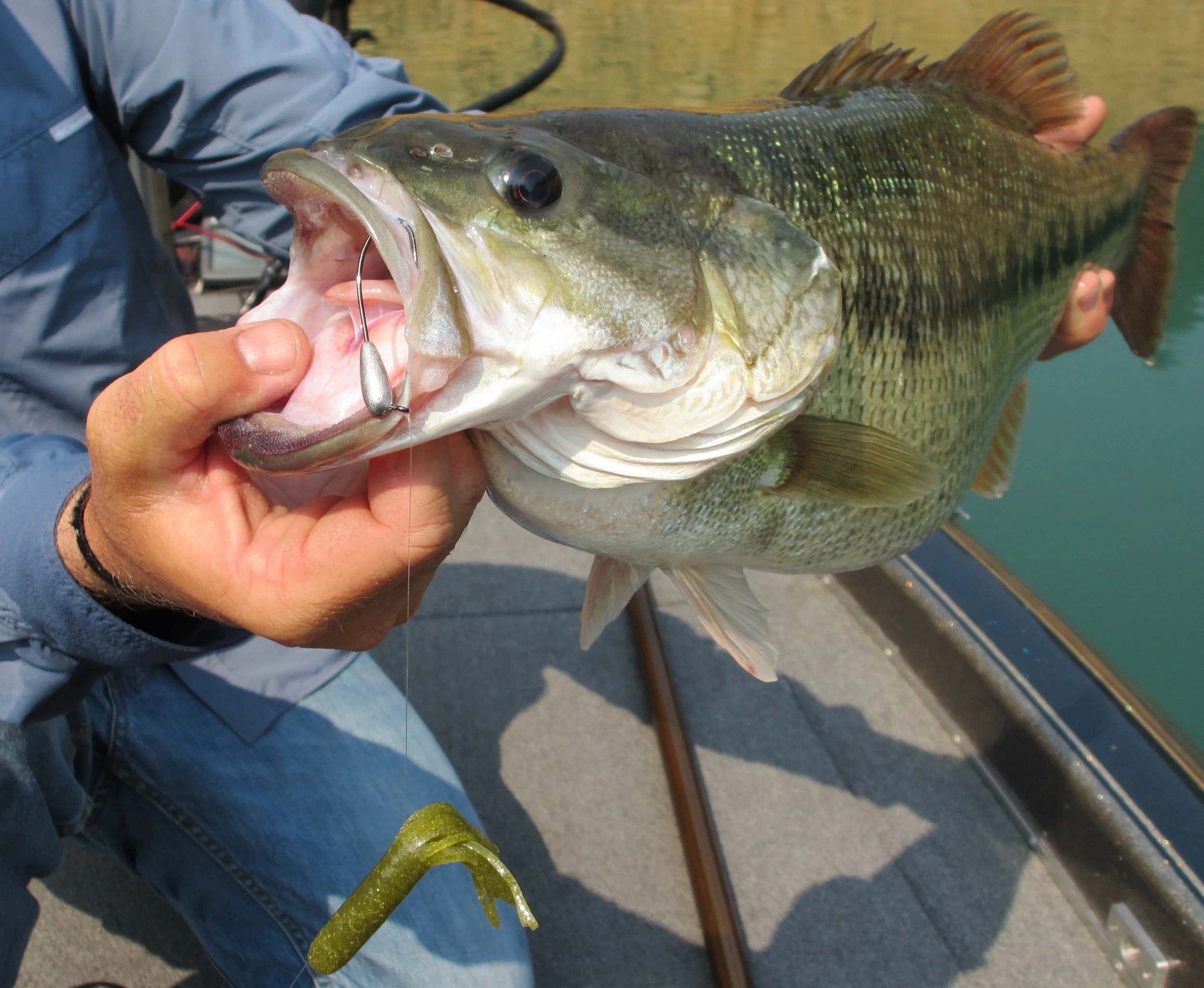
This "Old Ugly" tube slid up the line exposing the jig hook in this bass' mouth

This "Old Ugly" tube slid up the line exposing the jig hook in this bass' mouth

Where Tim prefers a 7'9" 2 power (medium light) rod, Matt prefers a 7'8" 3 power (medium) rod. **For those angler's looking for a shorter rod try the 742 or 743 Spinning Rods**

Both angler's prefer similar tubes but do not agree entirely on brand or color. Tim prefers the 3 1/2" Dry Creek Tube while Matt prefers the 3 1/2" tube from Get Bit Baits. The size is identical but the colors are different, as are the textures.

Lead heads are another point of disagreement. Tim adamantly believes in the 90 degree line tie of the Owner Darter Head. Matt prefers the 60 degree of the Bite Me Flat Eye Tube Jig with a 3/0 hook.

From Top to Bottom: Mud Pie, Green Pumpkin Purple/Gold, Old Ugly

The one aspect of their equipment that both anglers agree on is the weight of their line. Both use a 10-15 lb braided line (Sufix 832 or Power Pro) and connect it with a blood knot to 6-8 lb fluorocarbon. (Sunline for Tim and P-Line for Matt)

At the end of the day what you should take away from this article is that there isn't a right answer.

Both anglers have proven their style effective on all 3 major species of bass. Each has refined their approach to meet their style and needs on the water. Decide which style best fits your fishing and apply these tips to begin refining your tube fishing.


Senko Trick to catch more fish

The Yamamoto Senko is one of those baits that just flat out catches fish. Whether you're flipping heavy cover, skipping under docks, or fluttering the bait down bluff walls, it has a place in every well-rounded angler's arsenal. Have you ever wondered what it is that makes the Senko so deadly?


There is something unique about how a senko moves, but why does it work so much better than other stick baits? Well, we believe its all about the slight variation in shape that is specific to the Yamamoto Senko. Unlike other stick baits it is not truly round. When you take that difference in shape and rig it correctly, the bait becomes even more deadly than before.

The trick is to turn the bait until you find the flatter side with a slight arc to it. Rig the bait (Texas or Wacky) with the flatter side down. When the bait falls on a slack line you will have significantly more flutter and movement than if you had rigged it any other way. There truly is a right way to rig a senko.

Give it a try and let us know what you experience!

Line Extremes: Part 2

If you fish on a regular basis there is no doubt you’ve come across situations where bass become extremely line shy. This can result from weather changes, abnormally clear water, increased fishing pressure, or any number of other variables. Understanding HOW to react to this change in bass behaviour is more important than completely understanding WHY it is happening.

As I stated in the previous post on Line Extremes, I prefer heavy line. Given the opportunity I will pick up a big bait on heavy line rather than a finesse rig. Unfortunately, that isn’t always an option. When the fish get finicky I too turn to light line, extremely light line. Through years of on the water experimentation I’ve found what I consider to be a bass’ ultimate weakness. Before I make this statement I must admit, I am not a biologist and this is only my personal experience talking.

Bass can see most line. In clear water circumstances they can see (and visibly shy away from) 8 lb, 6 lb, and occasionally 4 lb line. When you get into the 3 lb range most bass can no longer see the line but occasionally one will react negatively. However, when you make the jump to 2 lb line, I truly believe it is invisible to all bass regardless of water clarity.

Fishing with such light line has its down sides. You will break fish off, no question about it. Fishing for big bass is inherently difficult, adding light line to the equation makes it that much more difficult. So why use such light line? Simple, you get the opportunity to hook bigger fish that wouldn’t have bit heavier line. With time and practice you will learn to play them out and your hook up to land ratio will be much higher than when you started.

From a tournament standpoint I don’t recommend fishing with 2 lb. If money is involved 4 lb line will get you a few less bites but has much more room for error. I’m not going to tell you one line is better than another for this style of fishing but I will recommend flourocarbon.
Check your local shop but if they don’t offer light enough line these guys will fill the gap. Flourocarbon Lines at Tacklewarehouse