What color swimbait should you choose?

Across the nation bass feed on a variety of prey species. Swimbait manufactures were quick to pick up on this and produce baits to match nearly any forage available to bass. On a typical store shelf you can find swimbaits that match everything from a rat, to a trout, to a goby. Without direction your only real option is to buy them all and see what works for you.
The good news is I already did the hard work for you! Over the last 10 years I’ve purchased nearly every swimbait to hit the market (with few exceptions) and have tried them in a dizzying array of colors. I’ve compiled all of that information into this quick video. I don’t cover every bait but I have a few quick tips that will help you select the right color for your situation.
You don’t need box after box of swimbaits, stick to the basics and you’ll do just fine. In fact, you’ll usually do better than the guy who spends all day digging through his boxes looking for the “magic” bait.

What swimbait colors do you have confidence in? Have your best days been on the realistic colors of some of the more extreme options? Leave a comment and share your thoughts.

River Fishing for Smallmouth

If all you care about is winning tournaments or catching giant bass it may be time to look at your priorities. Monster bass are a blast to catch but sometimes you need to take a break and remember what made fishing so fun in the first place. Fishing is about getting out on th water, relaxing, enjoying nature, and then catching fish.
Added to the list of fun ways to catch fish when you want to mix it up a bit: River fishing for smallmouth. Northern California (and most other places in the country) have an abundance of rivers that are completely full of undersized bass. These fisheries are rarely, if ever overfished and can provide a great fishing experience for children or a relaxing day on the water. The other perk to river fishing is you never know what you’re going to catch. On this outing we caught smallmouth, largemouth and sacramento pike. Its hard to beat that! (except maybe if you’re looking for a keeper-size fish, let alone a trophy.) While there are trophy class fish in rivers around the country most simply have healthy populations of modest-size fish.

Give it a try in a stream or river near you!

Top 5 baits for the Fall Transition

The late fall to early winter is one of my favorite times to fish. This season is one of the few times I have the lake all to myself. Sure, there are other fisherman on the water but they aren’t fishing like I am. No matter where you are in the country, as winter approaches anglers begin to slow down their presentation. Whether that mean throwing a worm, flipping a jig, or spooning, just depends on where you live. Sure you could give in to the trend and fish like everyone else but why?

Why not break away from the pack, fish hard, fish for the active fish, and have whole sections of the lake to yourself? As the water cools most of the bass will slow down and become sluggish and the fisherman will follow suit. Maybe this is your year to break out of the mold and find the feeding fish in and around the shallows. Here are my top 5 baits for fishing that transition between fall and winter.

You’ll notice the only bait on the list that isn’t a pure reaction bait is the football jig. At certain times the active fish are completely keyed on crawdads and that is when the football comes in to play. The rest of the time however, I’ll be fishing shallow, fishing fast, and putting the remaining 4 baits to work for me. If you want to catch a big bass in the fall that hasn’t been pressured like all the smaller fish be the last guy to leave the shallows, the last one to set down the topwater rod, and never, ever set down that swimbait.

Are these the baits you like to throw in the fall/winter? Is a late-season reaction bite news to you? What are your go-to baits in the fall?  I’d love to hear about it! Leave a comment and share your thoughts.
Who makes the best braid?

The previous post makes my stance on braid pretty clear. If you haven’t made the switch to braided line yet, its time. Now that we have that out of the way there are a few more details to consider. The term “braided line” actually includes a variety of different materials from a handful of companies. To properly understand braid you must begin by understanding that not all braid is created equal.
I’m not here today to advocate a single brand. However, I will tell you that before reading the following material I fished with power pro and P-Line Spectrex interchangeably. At this time, I’m not sure what I will be using in the future. I’ve always liked the thought of using a brand of braid that had more carriers, as they are typically smoother and more manageable. The downside to this, at least in my own thinking, is that they tend to be weaker overall than lines with only a few carriers. I’ve been arguing with myself about what brands to try and what options might meet my needs for over a year now.
On a recent trip I stumbled my way into the pages of Florida Sport Fishing Magazine. As I thumbed through the pages of the September/October issue I was happily surprised by an in-depth article on braided lines titled, “The 30 lb. Challenge, All braids are NOT created Equal”
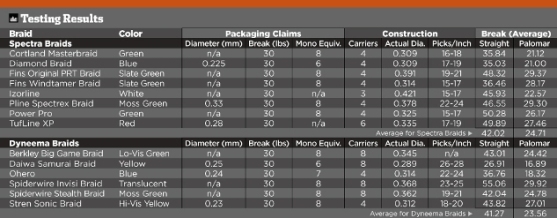
I was in for a treat! There are four primary factors that you need to consider when looking at a braided line. As explained in the article they are the fibrous material the braid is made of. (Typically Dyneema or Spectra fiber) The number of carriers (individual threads that will be weaved together to form the line), The “picks” per inch (this represents the number of times the carriers cross each other in the weaving process), and the final coating process.

Once you bring these four factors into play you can select a line that will meet your needs. In the meantime, I’m happy to share this graphic from the magazine. I hope you find it as helpful, eye-opening, and possibly even as much of a shocker as I did. As the title of the article stated, braids are NOT all created equal!

I have to admit that I was completely shocked by some of the results of these tests. Again, I am not here to promote any specific brand. However, after seeing these results I will personally be looking into a few different brands that may better suit my needs. I hope you’ve found this information useful!

If you’re interested in gaining a better grasp of how braided line is made and what separates one brand from another I highly recommend you visit the magazine’s website and contact them directly to try and pick up a copy of the September/October issue at: http://floridasportfishing.com/magazine/

Also, I beg you to support your local tackle shops. We’re in the midst of a tough market and they need all the help they can get. However, if you don’t have a local shop I recommend purchasing your braid from tacklewarehouse. Here is a direct link to their Braided line selection: http://www.tacklewarehouse.com/Braided_Fishing_Line/catpage-FLBRAIDED.html?from=tbassin

Did you enjoy this post? Was this information new? Leave a comment and let me hear your thoughts.