Wakebaits and Jigs

“Junk Fishing” is a term often used to describe a day spent on the water in which the fish were caught on a wide variety of lures or techniques with little rhyme or reason to seasonal or daily patterns. Junk fishing allows an angler to adapt to the surroundings instead of trying to force the fish to eat a certain lure. While I go into every trip with some sort of game plan the majority of my outings turn into a junk fishing day.

The exception to this rule is the night bite. I have confidence in a few key techniques and tend to use them exclusively to find fish in the dark. This night, however, was much different. We arrived at the lake with the intention of throwing wakebaits from sundown to sunrise. After a few hours and only one wakebait bite we began using other techniques. By the end of the evening our 5 best fish were caught on five completely different baits! It just goes to show you, even at night, the best policy is to adapt until you find the fish. Our five biggest bites came on 1) MS Slammer Wakebait, 2) Homemade Swimbait, 3) Zoom Brush hog w/ 3/8 oz weight , 4) Dirty Jigs 1/2 oz Flippin’ Jig and Uncle Josh pork Chunk, and 5) 6″ Yamamoto Senko.

Don’t be afraid to change it up! You just never know what you might catch.

Trophy Fish Photography: Part 2

Lighting is often overlooked in fish photography, because you often rely on sunlight. However, lighting does require some consideration because how you set up you’re photo changes your lighting, despite using natural light. Just keep these two rules in mind when setting up your next photograph.

Rule #1- Keep the sun at the photographers back

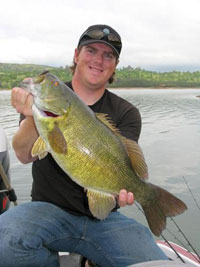
Matt 6.3 Smallie Washed Out

Matt 6.3 Smallie Washed Out

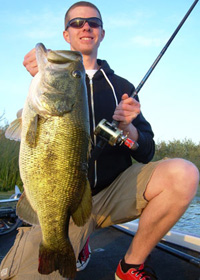
Kirk Spots Washed Out 

Kirk Spots Washed Out


Having the sun at the photographers back will help to prevent shadows on both the fish and the angler. Shadows on you’re face or the fish can ruin pictures, so remember to check you’re hat or anything else that could cast shadows before you get the fish out of the livewell.

Rule #2- Put more light on the fish’s back than its belly

If there is too much light on the fish’s belly, the color gets washed out like the pictures at the left and right, causing the fish to look pale. In order to get the best color in your photos make sure to get plenty of light on the fish’s back. Try to avoid taking pictures at high noon, as well, as that will wash out everything in the picture not just the fish.

A quick note on background selection:

Make sure your fish doesn’t blend into the background. In the picture at left, notice how the belly of the fish on the right blends into the light gray sky behind it.

Our Stance on Photoshop

We get a lot of questions about the use of photoshop in fish picture’s, and we believe that using photoshop only detracts from a picture. If you don’t want a landmark or any other identifying feature in a picture, don’t photograph fish in front of it. The best way to photograph fish so that your location isn’t obvious, is to select a solid background, such as a tulle wall of rock wall.

A Few Examples of Properly Taken Pics

Smallmouth Fishing

As some of you may already know I have a secret love for Brown Bass. In the early spring when the water first starts to warm I begin to forget about largemouth and focus my attention solely on smallmouth. There is something about the way they fight. It could be the huge jumps, or the powerful runs at the last second, but whatever it is, I’m hooked!

I hope you enjoy this video from earlier this year. I had the pleasure of spending a day on the water with my dad. It turned out to be a day to remember as he ended a fun-filled day with a smallmouth that tipped the scales past the 5 pound barrier

Are you a smallmouth junkie? I’d love to hear about it! Some of you are blessed to live in parts of the country where brown bass are the primary game fish and I’m sure you have stories to tell.